
Credit: Photo by Luis Melendez on Unsplash
Spending more on healthcare should mean better health outcomes, but that’s not always the case. According to the OECD’s Health at a Glance 2025 report, the United States spends much more on healthcare per person than other wealthy countries, yet it falls behind the OECD average in several areas, including life expectancy, preventable deaths, and deaths from treatable conditions. Of course, healthcare spending isn’t the only thing that affects people’s health. Income, education, living conditions, and other factors also matter. Still, this comparison makes us think about how healthcare systems spend their money and measure their results.
The U.S. spends heavily on medical research, technology, specialized treatments, and advanced medical tests. These investments are valuable, and spending more isn’t necessarily a bad thing. But healthcare costs also include administrative expenses, and medical services often cost more than in other wealthy countries. According to KFF’s analysis of healthcare spending, higher prices, rather than people using more services, explain much of the difference in U.S. spending. There’s a difference between ordering more tests and paying more for the same test. Understanding that difference matters when looking for ways to improve the system.
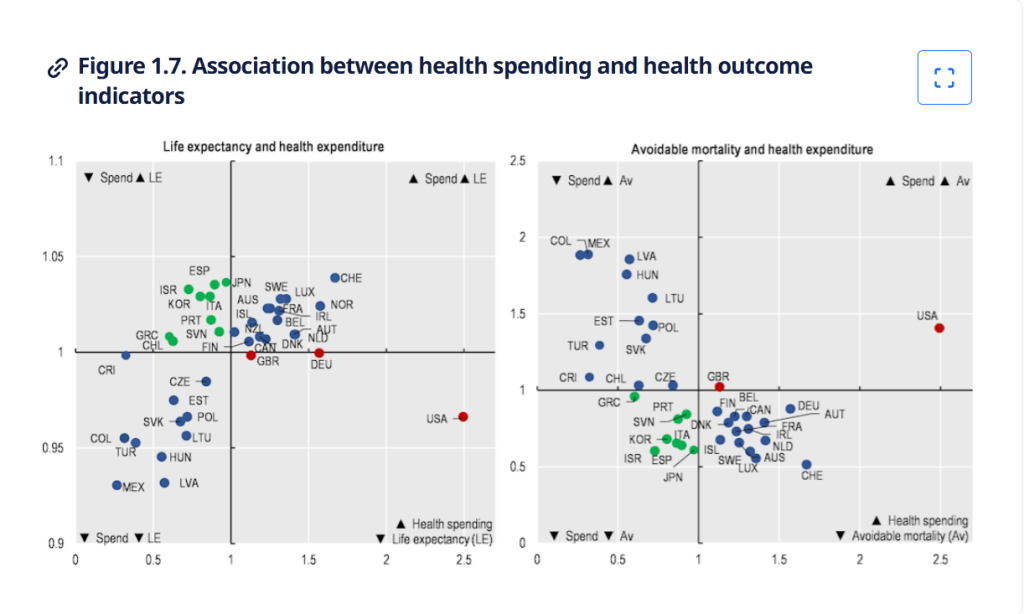
Healthcare systems are often measured using things like life expectancy, maternal and infant mortality, access to care, and preventable deaths. These measures help understand how healthy a population is, although they don’t tell everything about healthcare. At the same time, hospitals, insurance companies, and other healthcare organizations track revenue, patient visits, procedures, costs, and daily operations. These numbers are important for running their organizations and keeping them financially stable. But when looking at the healthcare system as a whole, providing more services doesn’t always mean people are getting healthier. Even an increase in patient visits could mean better access to care, more people getting sick, or both.
This is where business decisions become important. Healthcare systems have limited resources, so decisions about funding, staffing, and financial incentives affect what organizations focus on. For example, providing more health screenings may improve access, but those screenings won’t achieve much if patients who need treatment can’t get follow-up care. Prevention is another example. It often requires spending money today, while some of the benefits may not appear until years later. Both financial stability and quality care matter. Cutting costs by limiting necessary care isn’t a good solution, but improving services without enough money to keep them running isn’t sustainable either.
Healthcare systems already collect a lot of information about spending, services, quality, and health outcomes. The problem isn’t necessarily that we’re measuring the wrong things, but whether we’re using those measurements to make better decisions. Spending more, treating more patients, or providing more services can be signs of progress, but we also need to look at the results.
What do you think matters most when measuring the success of a healthcare system? I’d like to hear your thoughts in the comments.


Leave a Reply