
Credit: Photo by Greg Rosenke on Unsplash
Imagine going to a hospital and spending most of your day waiting. Maybe registration takes too long, the consultation line moves slowly, or you’re waiting for imaging results before a treatment decision can be made. Sometimes the delay happens when information needs to move between departments. Now imagine the hospital hires more staff at registration to reduce waiting times. Would that make the whole process faster? Not necessarily, especially if the real delay is somewhere else. This brings us to a business concept called the Theory of Constraints.
The idea is simple. A system can only move as fast as its main limiting step allows. Think of a hospital as a connected process where patients move through registration, consultation, testing, treatment, and sometimes referrals to other departments. If one department can handle 100 patients a day but the next can only handle 60, patients may start piling up at that second step. That is called a bottleneck. Adding more staff to the first department won’t necessarily help. It might even send more patients to the next step, making the waiting line longer. Of course, some procedures naturally take time, so not every delay means something is wrong.
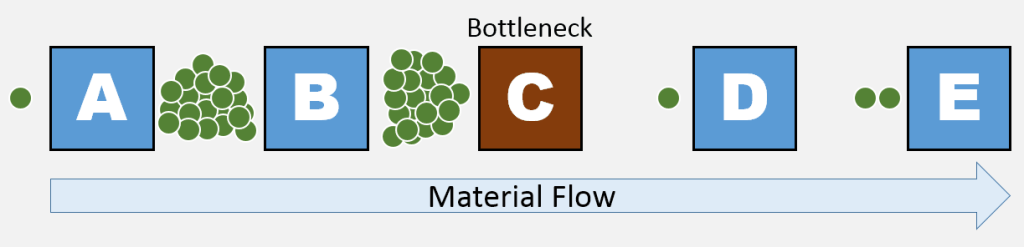
A study published in Health Systems gives a good example. An ophthalmology imaging practice applied the Theory of Constraints and increased the number of patients treated by 64% within a few weeks, with little additional expense. Instead of immediately buying more equipment or hiring more staff, the team focused on making better use of what they already had. The improvement wasn’t sustained after the person leading the changes left. So even when a solution works, keeping that improvement going can be another challenge.
Finding a bottleneck doesn’t always mean spending more money. Sometimes the problem is how work is organized. Maybe too many appointments are scheduled at the same time, imaging equipment is overloaded, samples take too long to reach the laboratory, or communication between departments slows down patient care. In some cases, changing appointment schedules, moving services closer together, or improving how departments share information might help. The Theory of Constraints’ five focusing steps encourage organizations to identify what’s slowing the system, make better use of that step, and improve its capacity when needed. The
Once one bottleneck is improved, another part of the system might become the slowest step. That’s why improving healthcare services isn’t a one-time activity. It requires regularly looking at how patients move through the system, listening to staff and patients, and making adjustments. A department might be meeting all its performance targets while patients are still spending hours moving through the hospital. So how do we know whether we’re measuring the success of individual departments or the experience of the entire patient journey?
Have you noticed a bottleneck in a healthcare service you’ve used or worked in? I’d love to hear your thoughts in the comments.


Leave a Reply